Sixth Catalog of Orbits of Visual Binary Stars — Web Search Interface
Results: 4051 rows (page 82)
Move the mouse over the image file to zoom in on the orbit or click on it for details and ephemerides.
| WDS designation |
Discover designation |
ADS number |
HD number |
Hipparcos number |
RA (2000) |
DEC (2000) |
image file |
orbit grade |
equinox |
last observation |
notes |
reference |
mag 1 (V) |
flag mag 1 |
mag 2 (V) |
flag mag 2 |
period |
P units |
P error |
semi-major axis |
a units |
a error |
inclination |
i error |
node (Omega) |
flag node |
node error |
time of periastron |
T0 units |
T0 error |
eccentricity |
e error |
longitude of periastron (omega) |
omega error |
|
23597-4405
|
WSI 140 |
|
|
|
235944.83 |
-440459.90 |
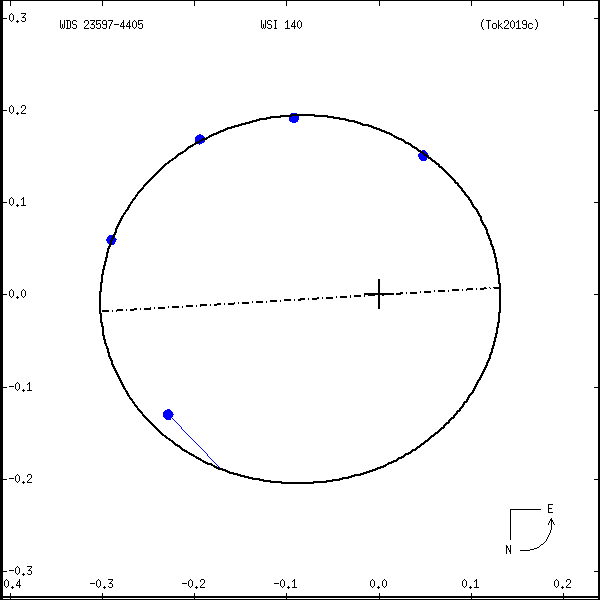
|
4 |
|
2018 |
|
Tok2019c
|
13.4 |
|
13.9 |
|
11.77 |
y |
0.39 |
0.217 |
a |
0.004 |
0.0 |
|
93.4 |
|
2.6 |
2001.98 |
y |
0.39 |
0.394 |
0.007 |
0.0 |
|
Description of Columns
RA (2000)               : epoch-2000 right ascension (hours, minutes, seconds)
DEC (2000)              : epoch-2000 declination (degrees, minutes, seconds)
WDS designation         : based on arcminute-accuracy epoch-2000 coordinates)
Discover designation    : Discover designation and components, or other catalog designation
ADS number              : ADS (Aitken Double Star catalog) number
HD number               : HD catalog number
Hipparcos number        : Hipparcos catalog number
mag 1 (V)               : Magnitude of the primary (usually V)
flag mag 1              : flag:
                          > = fainter than quoted magnitude
                          < = brighter than quoted magnitude
                          v = variable magnitude
                          k = magnitude is in K-band or other infrared band
                          ? = magnitude is uncertain
mag 2 (V)               : Magnitude of the secondary (usually V)
flag mag 2              : flag:
                          > = fainter than quoted magnitude
                          < = brighter than quoted magnitude
                          v = variable magnitude
                          k = magnitude is in K-band or other infrared band
                          ? = magnitude is uncertain
period                  : Period (P)
P units                 : Code for units:
                          m = minutes (not yet used!)
                          h = hours (not yet used!)
                          d = days
                          y = years
                          c = centuries (rarely used)
P error                 : Published formal error in P (in same units as for P)
semi-major axis         : Semi-major axis (a)
a units                 : Code for units:
                          a = arcseconds
                          m = milliarcseconds (mas)
                          M = arcminutes (used only for alp Cen + Proxima Cen)
                          u = microarcseconds (uas - not yet used)
a error                 : Error in a. Units are the same as for a
inclination             : Inclination (i), in degrees
i error                 : Error in i
node (Omega)            : Node (Omega), in degrees. An identified ascending node is indicated by
                          an asterisk following the value.
flag node               : If the ascending node is later determined to off by 180deg, it is flipped,
                          and a "q" code added to indicate the change.
node error              : Error in Omega
time of periastron      : The time of periastron passage (T0)
T0 units                : Code for units:
                          c = centuries (fractional year / 100; used only for alp Cen + Proxima Cen)
                          d = truncated Julian date (JD-2,400,000 days)
                          m = modified Julian date  (MJD = JD-2,400,000.5 days)
                          y = fractional Besselian year
T0 error                : Error in T0. Units are the same as for T0
eccentricity            : Eccentricity (e)
e error                 : Error in e
longitude of periastron : Longitude of periastron (omega), in degrees, reckoned
(omega)                   from the node as listed. If the published omega value
                          is later determined to fall in the wrong quadrant, the
                          value is flipped by 180deg; a letter "q" indicates the
                          quadrant has been corrected.
omega error             : Error in omega
equinox                 : Equinox, if any, to which the node refers
last observation        : Date of the last observation used in the orbit calculation, if published.
orbit grade             : Orbit grade, ranging from 1 ("definitive") to 5
                          ("indeterminate"). Additionally, a grade of 8 is used
                          for interferometric orbits based on visibilities
                          rather than rho and theta measures (hence not gradable
                          by the present scheme) and a grade of 9 indicates an
                          astrometric binary (also lacking rho and theta data).
notes                   : A clickable flag "yes" to any notes for this system.
reference               : A clickable code for the reference (usually based on the name of
                          the first author and the date of publication).
                          The bibcode in the references file is clickable and links to ADS.
image file              : Name of image file (png format) illustrating orbit and
                          all associated measures in the Washington Double Star
                          database.
The data presented here comes from the USNO website (updated: April 2026)